.svg)


Podcasting is no longer a single-market story. It has become a trusted, global advertising channel with real scale, strong engagement and growing strategic value for brands. Yet while audience demand is spread across multiple countries, media investment is still heavily concentrated in a small number of markets. For advertisers, that creates a meaningful opportunity: to find incremental reach in places where listener engagement is already strong, but spend has not yet fully caught up.
The Global Podcast Advertising Compass 2025 shows just how concentrated podcast advertising remains. In the report’s market comparison, the U.S. accounts for 86.6% of ad spend and 80.3% of listener share. This leadership makes sense. The U.S. is the most mature podcast advertising market and will remain essential for scale. But the data also suggests that the next wave of opportunity may come from looking beyond the most crowded market.
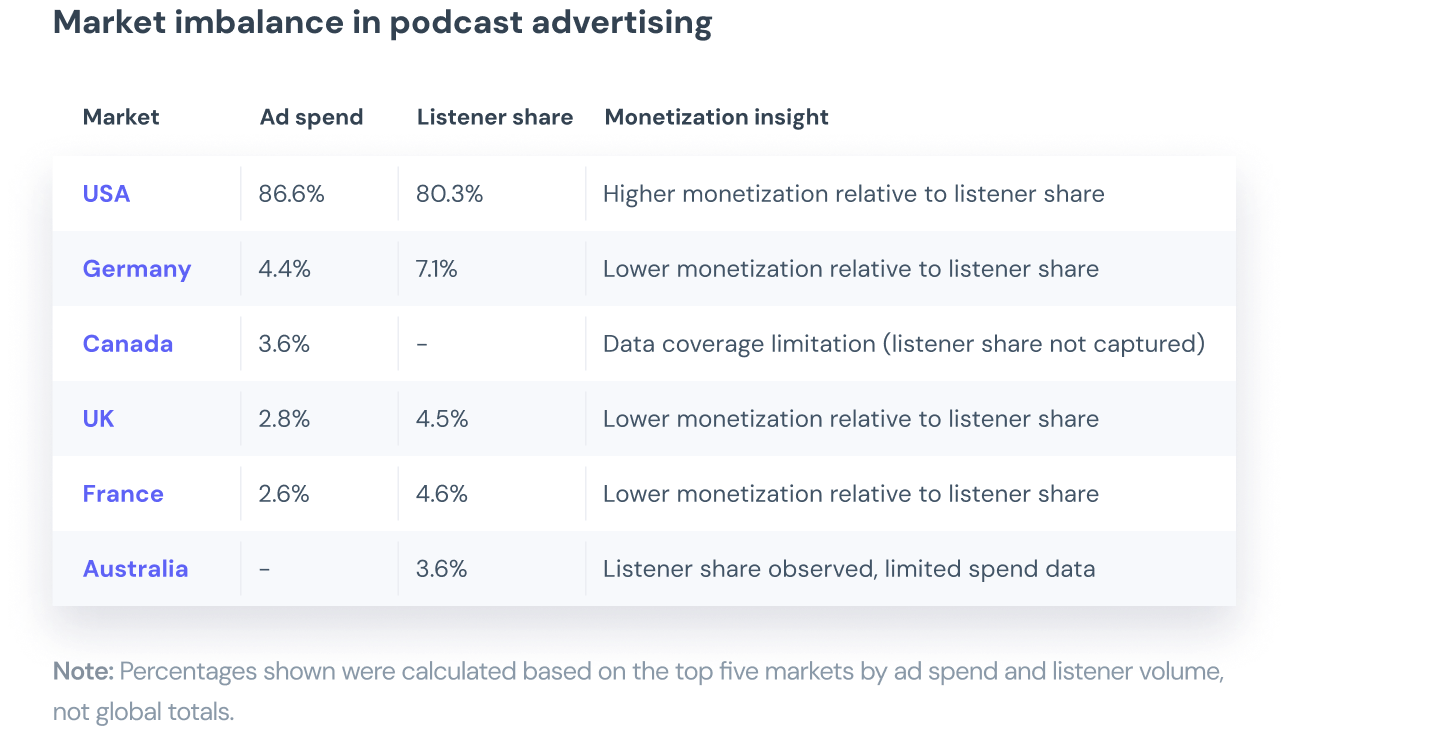
Germany, France, and the United Kingdom all show listener shares that exceed their relative ad investment. Germany accounts for 7.1% of listener share compared with 4.4% of ad spend. France accounts for 4.6% of listener share versus 2.6% of ad spend. The UK shows 4.5% of listener share and 2.8% of ad spend. Australia adds to the opportunity story: it represents 3.6% of listener share, and while spend visibility is limited in the dataset, the market suggests similar untapped potential.
These are not just statistical imbalances. For advertisers, they are signals that audience demand is present, while competition for podcast budgets may still be less intense than in the U.S.
What makes this especially relevant in 2026 is that more advertisers across categories are leaning into podcasting as a trusted, high-attention channel. The report shows that the top advertising verticals include Financial Services (18.5%), Media & Publishing (10.1%), and Travel (9.6%), while a much wider range of sectors is also building a presence. That matters because the opportunity is no longer limited to a narrow set of advertisers. More brands now have reason to treat podcasting as a scalable channel for cross-market growth, rather than a U.S.only one.
This creates a practical planning advantage. Expanding into markets where podcast listening is already strong can help advertisers find incremental reach outside their main market, test into less saturated environments and build international scale more efficiently. It also allows global brands to align creative and strategy to local audience behavior earlier, before those markets become more competitive.
The report also points to a practical route towards market expansion. In Q2 2025, 95.5% of campaigns with declared targeting parameters used contextual targeting, making it the dominant planning method in podcasting today. The foundation is already there. The next step is to make it smarter. NumberEight’s Affinity Audiences build on contextual signals with podcast-native audience intelligence, helping advertisers move from broad content alignment to more precise, scalable audience planning across markets. Instead of waiting for new infrastructure, brands can use these signals now to identify and reach the right audiences in markets where listener demand is already strong.
This is where the opportunity becomes more than geographic. It becomes strategic. The question is no longer just where to buy, but how to identify the right audiences within each market and activate them in a way that reflects how people actually listen. That is especially important in podcasting, where context, culture and listening habits vary significantly by country.
The report makes that point clearly in its Chapter 1 takeaway: markets like Australia, Germany, and France show strong listener engagement and comparatively lower investment, pointing to opportunities for global expansion. For advertisers, that is the real signal. These markets do not need to “prove” podcast demand. The listeners are already there. The opportunity is to act before budget patterns fully catch up.
For global advertisers, that is the key takeaway. Podcasting’s next phase of growth will not come only from pushing harder into the biggest market. It will come from recognizing where audience attention is already concentrated and using that insight to rebalance investment. The brands that do this well will not just gain reach. They will gain timing, efficiency and a head start in markets that are still opening up.
If you’re exploring where podcast advertising can drive incremental reach in 2026, NumberEight can help you identify the audiences and markets most likely to deliver it. Book a call to see how our Affinity Audiences can support smarter podcast planning and activation.