Podcast advertising has already found its default planning mode: contextual targeting. That is not surprising. Podcasts are long-form, content-led, and naturally suited to advertising strategies built around subject matter, tone, and adjacency. But if advertisers want to improve precision, scale, and performance in 2026, the answer is not simply to do more contextual targeting. It is to do smarter targeting, supported by stronger audience intelligence and more thoughtful use of suitability tools.
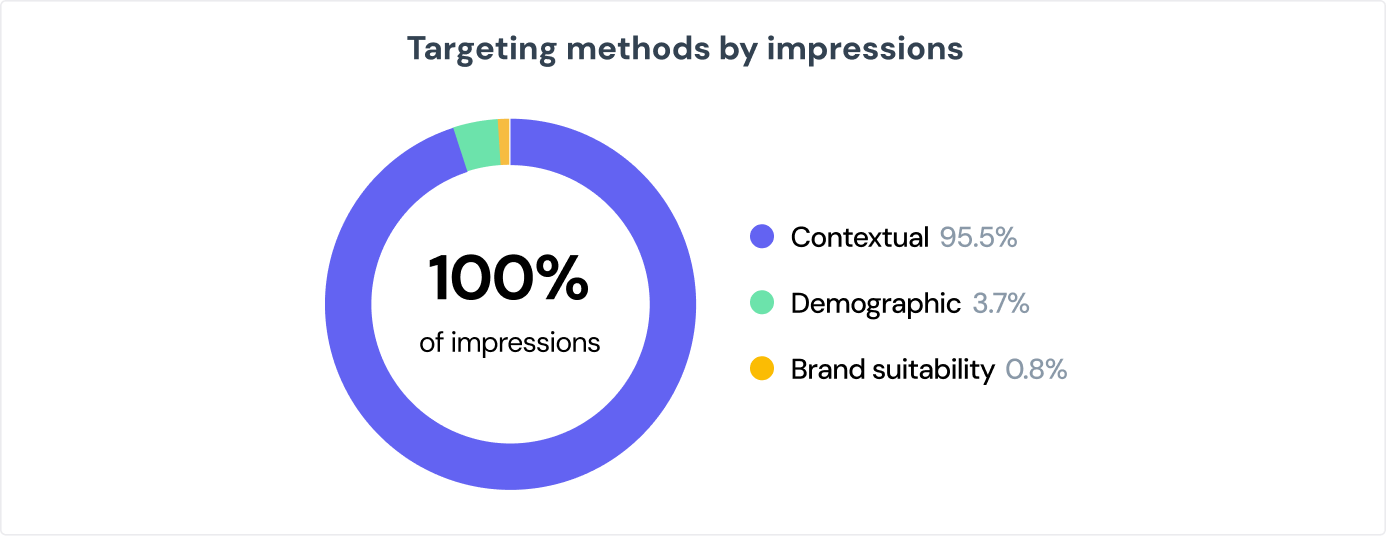
The data in the report makes that clear. In Q2 2025, 95.5% of podcast campaigns with declared targeting parameters used contextual targeting. By comparison, demographic targeting accounted for 3.7% and brand suitability targeting represented just 0.8%. Contextual targeting is not just leading podcast planning today. It overwhelmingly defines it.
That dominance makes sense. Podcasting is a content-driven medium, and contextual targeting offers a privacy-safe, scalable way to align ads with relevant environments. The report shows that contextual buying is already relatively sophisticated. At the IAB Tier-2 level, the most commonly targeted categories include Insurance (3.1%), Banks (2.7%), Buying and Selling Cars (2.4%), Grocery Stores (2.3%), and Credit, Debt and Loans (2.2%). At the broader Tier-1 level, the leading themes are Automotive (18%), Personal Finance (15%), and Technology & Computing (10%). This is not a narrow contextual landscape. It is already broad and commercially relevant.
But contextual targeting on its own can only go so far. It tells advertisers what a show or episode is about. It does not always tell them enough about who is likely to be there, how that audience differs by market, or whether the people reached in a relevant environment are actually the audiences a campaign is trying to reach.
A simple example shows why that matters. Take a luxury travel brand. Context alone might point it toward any travel podcast. But one of those shows could be about backpacking Southeast Asia on a shoestring, with listeners skewing toward students, deal-hunters and gap-year planners - a poor fit for premium holidays. Or the audience might look right, but the show’s tone could be full of profanity or explicit hostel stories, making it the wrong environment for a luxury or family-focused advertiser. Context only tells you the topic - audience intelligence tells you who is really there, and suitability tells you whether the setting fits the brand. That is the limitation of context on its own - and the case for adding smarter audience and suitability layers.
The report shows that when demographic targeting is used, it is applied in a very concentrated way. Listeners aged 25–34 receive 43.5% of demographic-targeted impressions, more than double any other age segment. Female-targeted campaigns account for 11.4% of impressions compared with 6.4% for male-targeted campaigns. In other words, demographic targeting is not yet being used as a broad optimization layer. It is mostly focused on a narrow set of familiar audience groups.
That leaves a lot of value on the table. Elsewhere in the report, we see that podcast audiences are not concentrated around a single life stage or identity. Millennials dominate overall, but Gen Z and older listeners are both meaningful in different ways and in different markets. Gender patterns also shift substantially by country and category. Relying on context alone risks flattening these differences when they could instead be used to sharpen planning and improve creative fit.
This is not only about choosing the right content environment. It is about understanding which audiences are most likely to be reached within that environment, and using that insight to make planning more precise.
This is where NumberEight’s Affinity Audiences can add value. Rather than replacing contextual planning, they make it more useful. They build on contextual signals with richer demographic and audience insight, helping advertisers move from broad content alignment to more precise, market-specific planning. That allows brands to identify not just the right topic, but the right listener profile within that topic.
Suitability also plays a role here, but as part of a broader targeting mix rather than as a blunt final filter. The report shows that brand suitability targeting remains a very small share of podcast activity overall. That does not mean it is unimportant. It means it is currently underused and often treated too narrowly. In practice, suitability works best when it helps advertisers calibrate tone, language, and topic sensitivity in ways that support brand goals without undermining the relevance established through context and audience planning.
This is one reason the partnership with Barometer matters in the report. Barometer’s analysis brings podcast-native nuance to the suitability layer, making it easier to understand how advertisers can apply controls that fit the medium rather than relying on assumptions borrowed from other channels. Most monetized podcast content is already suitable for brands, with the majority of shows falling into Low Risk or No Concern across nearly every category. That makes suitability less about broad avoidance and more about thoughtful calibration.
Taken together, the findings suggest that the future of podcast targeting is not about choosing one tool over another. It is about using the right tools in combination:
- Contextual targeting to establish relevance and content alignment
- Audience intelligence, such as NumberEight’s Affinity Audiences, to sharpen who is likely to be in that environment
- Suitability tools, supported by Barometer’s podcast-native analysis, to calibrate tone, language, and topic sensitivity
That is a more complete model for podcast planning. It reflects how the medium actually works, and it gives advertisers a clearer path to balancing reach, relevance, and brand fit.
The report’s broader conclusion is that podcast advertising is already growing in both depth and breadth, but there is still room for greater sophistication in how audiences are reached and measured. Contextual targeting may dominate today, but the next gains will come from smarter combinations of context, audience, and suitability. That is the shift advertisers should be making now.
For advertisers planning 2026, the message is straightforward. Podcast targeting does not need to become more complicated for the sake of it. It just needs to become more complete.
To build podcast targeting strategies that combine context, audience intelligence and suitability more effectively, book a call to find out what Affinity Audiences can do for you.